Ebook Download The Tree of Yoga (Shambhala Classics), by B.K.S. Iyengar
A brand-new experience can be gained by reading a book The Tree Of Yoga (Shambhala Classics), By B.K.S. Iyengar Also that is this The Tree Of Yoga (Shambhala Classics), By B.K.S. Iyengar or various other publication collections. We offer this publication since you could find more things to motivate your skill and knowledge that will certainly make you much better in your life. It will certainly be additionally useful for the people around you. We suggest this soft documents of guide here. To understand how to get this book The Tree Of Yoga (Shambhala Classics), By B.K.S. Iyengar, read more below.
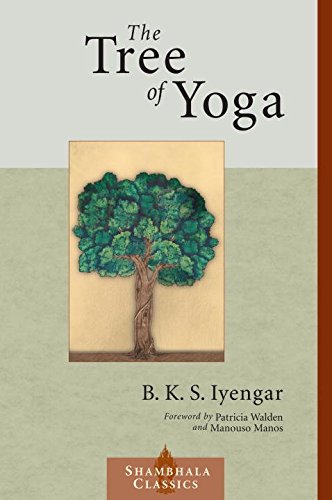
The Tree of Yoga (Shambhala Classics), by B.K.S. Iyengar

Ebook Download The Tree of Yoga (Shambhala Classics), by B.K.S. Iyengar
Utilize the sophisticated innovation that human establishes this day to locate guide The Tree Of Yoga (Shambhala Classics), By B.K.S. Iyengar quickly. But initially, we will certainly ask you, just how much do you enjoy to review a book The Tree Of Yoga (Shambhala Classics), By B.K.S. Iyengar Does it always up until surface? Wherefore does that book check out? Well, if you actually like reading, attempt to review the The Tree Of Yoga (Shambhala Classics), By B.K.S. Iyengar as one of your reading compilation. If you just checked out the book based on requirement at the time and incomplete, you have to attempt to such as reading The Tree Of Yoga (Shambhala Classics), By B.K.S. Iyengar first.
When some people considering you while reading The Tree Of Yoga (Shambhala Classics), By B.K.S. Iyengar, you might feel so proud. Yet, as opposed to other individuals feels you should instil in yourself that you are reading The Tree Of Yoga (Shambhala Classics), By B.K.S. Iyengar not because of that reasons. Reading this The Tree Of Yoga (Shambhala Classics), By B.K.S. Iyengar will give you more than people admire. It will certainly overview of recognize greater than the people staring at you. Already, there are several sources to discovering, reading a book The Tree Of Yoga (Shambhala Classics), By B.K.S. Iyengar still ends up being the first choice as an excellent method.
Why must be reading The Tree Of Yoga (Shambhala Classics), By B.K.S. Iyengar Again, it will rely on just how you feel and also think about it. It is undoubtedly that a person of the perk to take when reading this The Tree Of Yoga (Shambhala Classics), By B.K.S. Iyengar; you can take much more lessons straight. Even you have not undergone it in your life; you could get the experience by reviewing The Tree Of Yoga (Shambhala Classics), By B.K.S. Iyengar As well as currently, we will present you with the on the internet publication The Tree Of Yoga (Shambhala Classics), By B.K.S. Iyengar in this website.
What type of publication The Tree Of Yoga (Shambhala Classics), By B.K.S. Iyengar you will favor to? Currently, you will not take the printed book. It is your time to obtain soft data book The Tree Of Yoga (Shambhala Classics), By B.K.S. Iyengar instead the published files. You could appreciate this soft documents The Tree Of Yoga (Shambhala Classics), By B.K.S. Iyengar in at any time you expect. Also it remains in anticipated location as the other do, you can review the book The Tree Of Yoga (Shambhala Classics), By B.K.S. Iyengar in your gadget. Or if you want much more, you could read on your computer or laptop computer to obtain full screen leading. Juts find it here by downloading and install the soft file The Tree Of Yoga (Shambhala Classics), By B.K.S. Iyengar in web link web page.
Iyengar developed a form of yoga that focuses on developing strength, endurance, correct body alignment, as well as flexibility and relaxation. The Iyengar method integrates philosophy, spirituality, and the practice of yoga into everyday living. In The Tree of Yoga, Iyengar offers his thoughts on many practical and philosophical subjects including family life, love and sexuality, health and the healing arts, meditation, death, and Pata�jali's Yoga Sutras. This new edition features a foreword by Patricia Walden, a leading American teacher of the Iyengar style.
- Sales Rank: #36844 in Books
- Published on: 2002-03-26
- Released on: 2002-03-26
- Original language: English
- Number of items: 1
- Dimensions: 8.97" h x .60" w x 5.96" l,
- Binding: Paperback
- 208 pages
Review
"Valuable insights into the therapeutic nature of yoga. . . . Those already familiar with Iyengar's work will find subtlety and depth here that will increase with each rereading."— Yoga Journal
"The well known Iyengar, a yoga teacher for fifty years and family man with six children, offers valuable teachings that are consistently lucid, inspiring, and instructive."— East West
From the Inside Flap
One of the world's foremost teachers of yoga offers his thoughts on many practical and philosophical subjects, ranging from the place of yoga in daily life to insights from Patanjali's "Yoga Sutras".
About the Author
B. K. S. Iyengar lives in India and travels throughout the world to teach the many people who study his methods of yoga practice. He is the author of Light on Yoga and Light on Pranayama.
Most helpful customer reviews
1 of 1 people found the following review helpful.
What a great book. I will admit he has a way ...
By Jennifer Jennings
What a great book. I will admit he has a way of making me feel like my progress in yoga is not progress at all...but that is the point. One must be ready to read this book, and be ready for the feelings that will come up. It is well written and pretty easy to understand but don't expect it to be a cake walk. Some of the chapters are very short but are filled with such information you need to read more than once. I can honestly say that I have grown tremendously from reading this book and my asana practice has also grown. There a If you're ready to grow your yoga practice then GET THIS BOOK.
3 of 3 people found the following review helpful.
Beautiful meditations on practicing and teaching yoga
By Craig Shoemake
While I find I enjoy and benefit from anything Iyengar writes, I was actually more impressed by this book than I had expected to be. I did not go into it with any particular expectations--perhaps that helped--except the very positive reviews on Amazon. It is not an asana book, and Iyengar not being a scholar (he does not even have a high school degree he says on page 28, and was a "dumb student"), it is not a "learned" tome of any sort. This book is, rather, a subtle, gentle, at times revealing, and quite elegantly written series of reflections on the practice and teaching of yoga. Mr. Iyengar may not have been much of a student (what does this say about schools, I wonder?), but this book is clearly the product of an intelligent, discerning, and dedicated life.
It is divided into five parts: (1) "Yoga and Life," with essays describing generally the traditional Hindu view of the life process and how yoga fits in with that; (2) "The Tree and Its Parts," where the eight limbs defined in Patanjali's Yoga Sutras are described; (3) "Yoga and Health," which is pretty self-explanatory; (4) "The Self and Its Journey," examining the higher practices of pranayama and meditation leading to samadhi; and (5) "Yoga In the World," which has only two essays, the first about yoga as an art form, the second about the requirements and responsibilities of yoga teachers.
Although Iyengar does quote a bit of Sanskrit here and there, I would not say any of the essays are particularly "technical," though this is certainly not to say they are at all superficial. Quite the opposite--this book could not have been written by someone who was anything less than a master of his field, with long years of experience and reflection. Which leads me to say that although anyone can read this book--beginner or advanced, the merely curious to the hardcore--what you get out of it will definitely be determined by the depth of your own practice. Many rereadings, particularly when one is at different stages of development, or when one has perhaps crossed the line from student to teacher, will no doubt yield new insights and understandings.
I'd like to share a few points of what, for me, were highlights. Mr. Iyengar has a way with analogies, and a brilliant one is found on page 17, where the four original castes (peasant, merchant, warrior, priest) are compared to attitudes or states of mind. His essay entitled "Childhood" (20) was simply beautiful, and I found the description of some of his life contained in "Family Life" (27) very inspiring. The second part of the book is an excellent overview of yoga practice as a way of meditation and illumination; I thought in particular the notion of the Eight Limbs (ashtanga) of Patanjali as a hologram (see "The Roots," page 50) to be nothing if not brilliant. There are, in fact, many very insightful and illuminating passages in this section, things I never thought about in quite that way. His discussion of yoga as a healing art (especially from p. 93ff) was very interesting--I wish he would write a whole book devoted to his experiences in this regard. I could go on, as there are many excellent passages, but lastly I will cite p. 117ff as a brilliant evocation of why the Buddhist practice of mindfulness is so easily in accordance with the practice of asanas. Iyengar writes:
"Conciousness is always present in our finger, but most of the time we are not aware of it, so the consciousness of the finger is dormant. You should know the difference between consciousness and awareness. Consciousness exists everywhere in the body. When you are walking, if a thorn touches your foot, what happens? It pricks, and you immediately feel the pain, so you cannot say that consciousness was not there. But until he thorn pricked you, you were not aware of your foot. The consciousness in your foot was dormant, but the moment the foot was pricked, it was brought to the surface. To awaken that dormant consciousness is awareness. Your consciousness is six feet long, or five and a half feet long in your body--it is as long as your body is tall. But awareness is small. Awareness may extend two feet, one foot, one inch or half an inch. The yogi says that by practising asanas, you can bring awareness to an extension equal to that of consciousness. This is total awareness. This is meditation."
Mr. Iyengar is of course a hatha yogin, and while practicing asanas may take you a long ways, I do not feel it is a substitute for a hard-core sitting practice. This may be the area where he comes up short, and indeed, the only passage of the book that I thoroughly disagreed with revealed this. On p. 139 he writes:
"If you work diligently on asana, pranayama and pratyahara, you will receive your reward of dharana, dhyana and samadhi, which are the effects of that practice. They CANNOT BE PRACTISED DIRECTY [emphasis added]. If we say that we are practising them, this means that we do not know the earlier aspects of yoga. It is only by practising the earlier aspects that we can hope to arrive at their effects."
I don't agree with this at all. In fact, as a statement of the reality of meditation practice (especially in the Buddhist tradition, pick your yana), it is patently false. All over the Buddhist world (not to mention the Christian, Muslim, Jain, Hindu, etc), people come to meditation without ever having practiced asanas or pranayama, and many of them do just fine. Might they benefit from asanas? Of course! But, as Iyengar showed quite eloquently, the Path can be approached and the Goal attained through any of the limbs of yoga (though some are more direct and less time-consuming). While I do not wish to make overmuch of this one little misstep in an otherwise superb book, I do think it points out a shortcoming in Iyengar's approach, which appears marked by an imbalance favoring asanas over direct meditation practice.
This aside--which is just my nitpicking--I cannot recommend this book enthusiastically enough to anyone exploring the world of yoga. Read it, practice, reflect, and reread it. Do not read it for information, rather for grounding, seasoning, maturation. If yoga is a tree (and since Mr. Iyengar says it is, who are we to argue?) then read it and learn to think like a tree--to make my own unworthy stab at a different sort of analogy!
1 of 1 people found the following review helpful.
Sue in OH
By Suzanne C
Wonderful reference book that explains the philosophy of yoga in simple terms. It helped me to understand why the symbol of the tree is so helpful to my practice and gives me something to aspire as I continue learning.
See all 41 customer reviews...
The Tree of Yoga (Shambhala Classics), by B.K.S. Iyengar PDF
The Tree of Yoga (Shambhala Classics), by B.K.S. Iyengar EPub
The Tree of Yoga (Shambhala Classics), by B.K.S. Iyengar Doc
The Tree of Yoga (Shambhala Classics), by B.K.S. Iyengar iBooks
The Tree of Yoga (Shambhala Classics), by B.K.S. Iyengar rtf
The Tree of Yoga (Shambhala Classics), by B.K.S. Iyengar Mobipocket
The Tree of Yoga (Shambhala Classics), by B.K.S. Iyengar Kindle
The Tree of Yoga (Shambhala Classics), by B.K.S. Iyengar PDF
The Tree of Yoga (Shambhala Classics), by B.K.S. Iyengar PDF
The Tree of Yoga (Shambhala Classics), by B.K.S. Iyengar PDF
The Tree of Yoga (Shambhala Classics), by B.K.S. Iyengar PDF

![[ [ [ The Wedding Girl[ THE WEDDING GIRL ] , by Wickham, Madeleine ( Author )Jun-22-2010 Paperback, by Madeleine Wickham](https://lh3.googleusercontent.com/blogger_img_proxy/AEn0k_uZb9aL6qxxRrWFZYBWxZHt8UAgUh8A0vLaGDiyEBnrZeVprVD3d-UJEaHGSdkveNm7xXdLnvKXSnflI9S2ejgeg8DWwXXYSXAZhyN883D3UHzYxz2MMPs=s0-d "[ [ [ The Wedding Girl[ THE WEDDING GIRL ] , by Wickham, Madeleine ( Author )Jun-22-2010 Paperback, by Madeleine Wickham")
![[ [ [ The Wedding Girl[ THE WEDDING GIRL ] , by Wickham, Madeleine ( Author )Jun-22-2010 Paperback, by Madeleine Wickham](https://lh3.googleusercontent.com/blogger_img_proxy/AEn0k_tscIFG00nHnUs0BILQOd4gJO2CxWtyuXFjCvqUNmT1rLGlbmdlDvXdYwWNA_UW-qauroYNL1N40hxwK4MJpHga2vRsBQ=s0-d "[ [ [ The Wedding Girl[ THE WEDDING GIRL ] , by Wickham, Madeleine ( Author )Jun-22-2010 Paperback, by Madeleine Wickham")


